
Weight Bench
- Buying a weight bench
- What is a weight bench?
- What is a weight bench with weights?
- What is the difference between a flat bench and an incline bench?
- Difference between a weight bench and a training bench: What you need to know
- What should you look out for when buying a weight bench?
- The benefits of strength training with a weight bench
- What exercises are possible with a weight bench?
- Where can I test a weight bench?
- FAQ
Buying a weight bench
The ultimate guide for your strength training at home
A weight bench is the key to effective and versatile strength training within your own four walls. As an indispensable part of your home gym, it allows you to take your workout to the next level. But before you decide to buy one, it's important to consider all aspects.
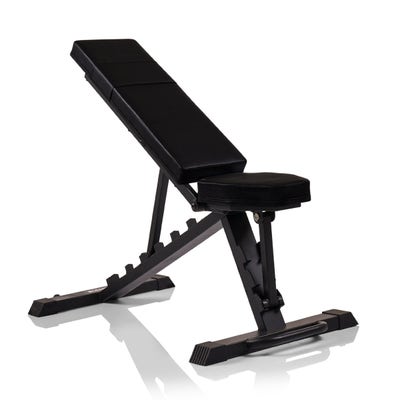
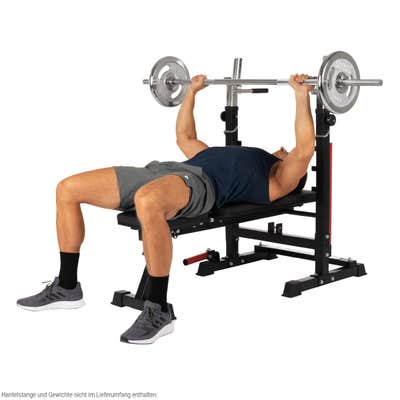
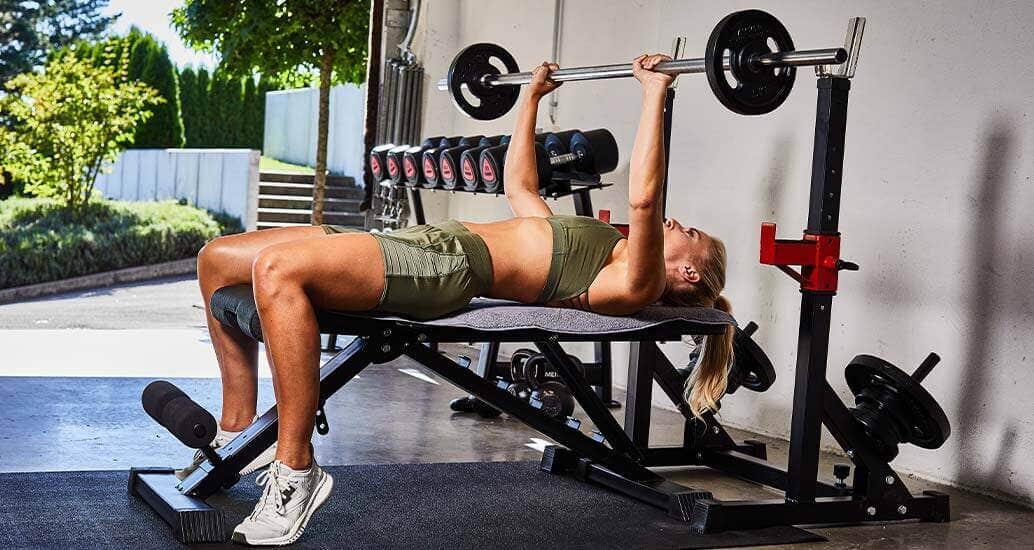
For varied strength training with free weights, a weight bench or training bench is simply a must. It helps you to perform movements correctly and work different muscle groups at the same time. A weight bench saves space and can be used as a flat bench or incline bench. In combination with a barbell or dumbbell set, it allows you to perform numerous exercises and is your perfect training partner for intensive and extensive strength training at home.
Anyone looking to buy a weight bench is often confronted with a wide range of different features. In order to make an informed purchase decision, it is important to find out about different models, exercise options and quality features. This guide will tell you everything you need to know to find the perfect weight bench for your needs. Combining this information will give you a comprehensive overview of the benefits of a weight bench and the most important factors to consider when buying one. This way, you can ensure that you make the best choice for your home workout and achieve your fitness goals effectively.
What is a weight bench?
A weight bench is a classic piece of training equipment from , which is usually used in combination with , a and to train different muscle groups. The weight bench supports you in maintaining a stable and ergonomic training position during strength training. With a training bench, a set of dumbbells, a barbell and weights, you already have countless exercises at your disposal for effective dumbbell training.
Although there are many exercise options with a weight bench, depending on the model, the machine is particularly well-known and popular for bench presses with a barbell. This and many other barbell exercises are particularly effective for building muscle and are especially interesting for home use due to their space-saving dimensions and flexible application options. In order to enable an even greater range of exercises and to train all muscle groups in an even more differentiated way, some weight benches also have additional training options.
HAMMER weight benches impress with their quality, functionality and price. Order your weight bench easily and risk-free with free delivery to your home. If you don't like the training bench, you can return it to us free of charge within 14 days.
What is a weight bench with weights?
A weight bench with weights is one of the most popular and versatile pieces of exercise equipment for anyone who wants to improve their fitness at home or in the gym. This particular type of workout bench allows for a wide range of exercises that help build muscle mass, increase muscle strength and improve overall fitness.
What is the difference between a flat bench and an incline bench?
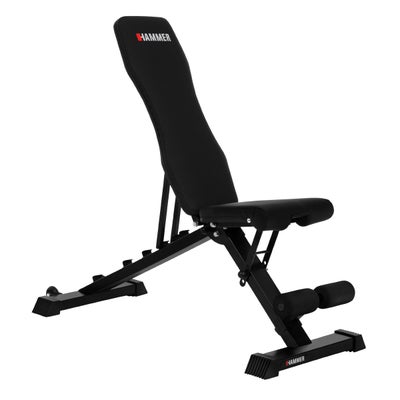
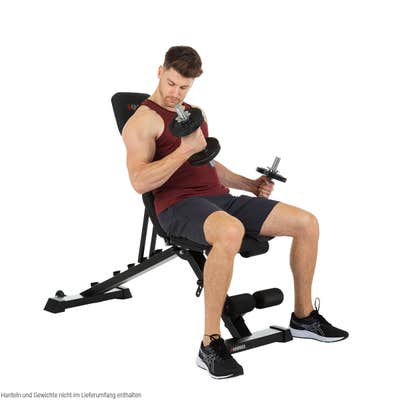
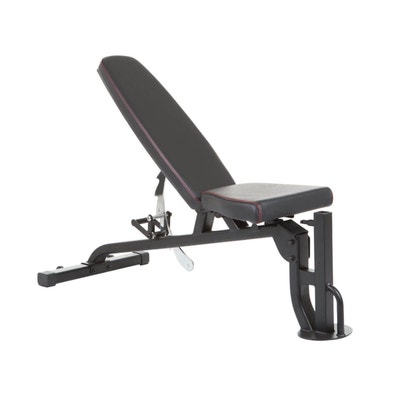
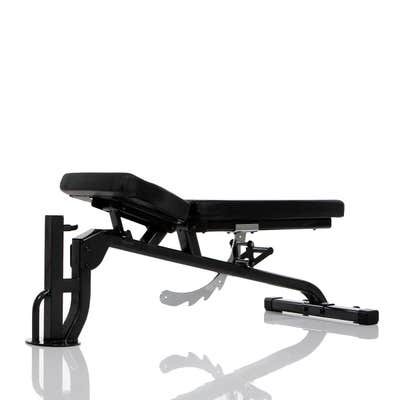
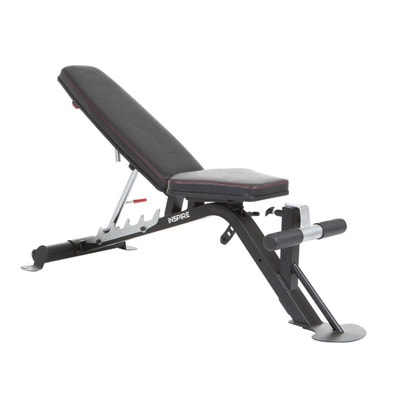
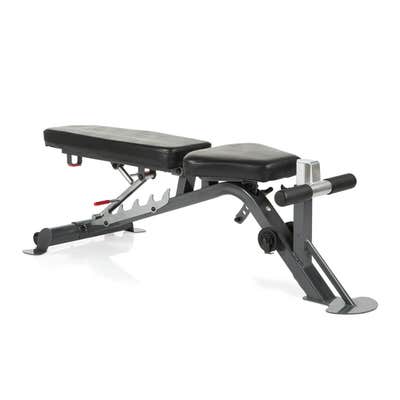
The classic among training benches is definitely the flat bench, with which you can already perform many exercises safely. However, as changing the training angle in strength training makes a relevant difference for many exercises, the incline or negative bench is a useful addition and offers better ergonomics and a better training position depending on your body measurements. An incline bench allows you to adopt a more upright position, while a decline bench enables a lower head position. By adjusting the angle, you can achieve a differentiated muscle response, e.g. when bench pressing, and benefit from an individually optimised body position during weight training. Furthermore, an inclined setting of the backrest for seated bicep curls can also emphasise individual muscle fibres more strongly, whereas a negative bench with intensive crunches also challenges your abdominal muscles. When buying a weight bench, make sure that the backrest can be adjusted. If this is available, the weight bench is often referred to as an incline bench, although flat and negative bench settings are also possible.
Difference between weight bench and training bench: What you need to know
Compared to a weight bench, a training bench is more versatile and less specialised in pure strength training. It offers a stable surface for a wide range of exercises, both with and without weights. You can use it for push-ups, step-ups, abdominal exercises and many other exercises. Some models even come with integrated pulleys or other features that offer you additional training options.
So what's the right choice for you?
If you want to focus on strength training with free weights, a weight bench would be ideal. However, if you're looking for more versatility and perhaps don't always want to work with weights, a training bench might be a better fit for your goals. Remember that regardless of your choice, the quality and stability of the bench is crucial. After all, you want to train safely and effectively.
What should you look for when buying a weight bench?
Regardless of the design, a weight bench should fulfil the basic requirements of fitness equipment such as high safety and stability. A stable construction made of high-quality materials is an absolute must for weight training. Pay attention to the total permissible load on the equipment, which is calculated from your body weight plus the training weight you are using. HAMMER training benches have a load capacity of at least 135 kg.
Total load barbell and support
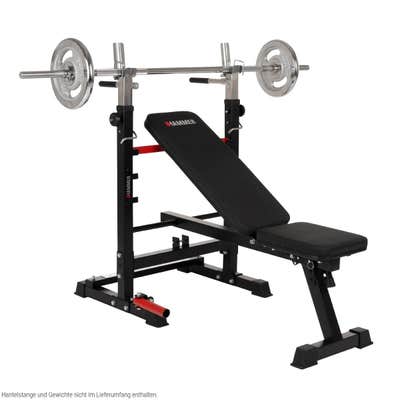
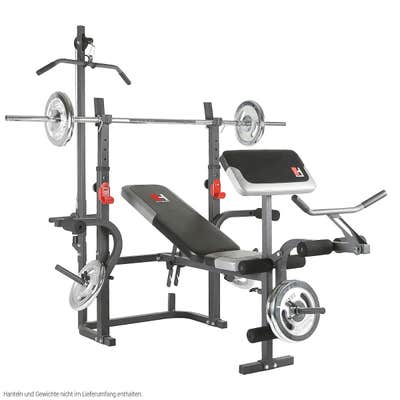
Furthermore, a total load is also specified for the barbell holder and the barbell itself, which you should definitely take into account. Advanced weight benches such as the also offer features such as support bars for the weights and locks for additional safety during strength training.
Back pad and dumbbell rack adjustment
For a wide range of exercises and a variable training position, it is necessary to adjust the back pad. It is therefore advisable to ensure that the backrest can be tilted and that the adjustment mechanism is smooth-running. If you are tall or have long arms, you should also look for an ergonomic training position and an adjustable dumbbell rack. Equipment such as the allows you to adjust the width of the dumbbell rack as well as the training angle and rack height, offering even more scope for personalised training.
Areas of application and fitness goals
Of course, you should also select your weight bench according to your personal areas of application and fitness goals. For example, if you are just starting out with strength training, a weight bench from the FT series and a dumbbell set is a good choice, whereas advanced athletes will appreciate the additional functions of the Bermuda XT series for strength training of all muscle groups.
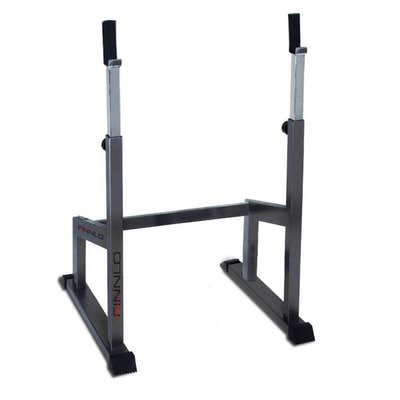
Depending on what equipment your home gym already has, you will also need to choose the right incline bench. If you already train with a barbell, your weight bench should also have a rack for it. If, on the other hand, you already have a , a weight bench without a barbell rack is more suitable. Also pay attention to the space available and the dimensions of the bench so that you always have enough room for your home workouts. If space is limited, we recommend the multifunctional bench , for example, which can be stored in a completely foldable position.


Should I buy a weight bench with weights and barbell?
In addition to your training bench, we recommend a dumbbell set such as the to make your strength training at home a success. If your incline bench has a barbell holder or you already have a barbell rack, a barbell with weights is of course also useful for a comprehensive workout.
If you want to start training immediately after buying a weight bench, it's best to go for inclusive! In addition to dumbbell and barbell exercises, you can also perform typical studio leg exercises and butterfly exercises with the weights supplied, which train all muscle groups.
The benefits of strength training with a weight bench
The advantage of strength training with a weight bench and weights is that you can upgrade your home gym according to your training progress. By using free weights and bars, additional can be added to provide an appropriate training stimulus in the long term. In this case, a separate is often recommended for a safe and tidy home gym. When buying the weights separately, make sure that the hole diameter corresponds to that of your dumbbell bars. For additional training comfort and safety, and a are useful additions to the weight bench.
What exercises are possible with the weight bench?
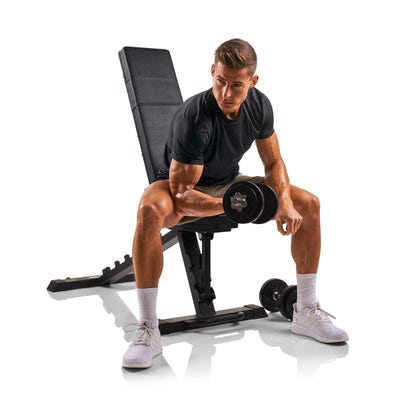
A classic flat bench with weights can be used to train all muscle groups. Train your chest muscles with bench presses and flyes as well as your back with dumbbell rows. Seated shoulder presses, bicep curls, hip thrusts, split squats, bench dips and tricep presses are also highly effective exercises that you can perform with a weight bench. In this article you will find further training examples to train your upper arms. In combination with other equipment such as a , you can benefit from even more exercise variations. Here you will find 10 effective dumbbell exercises for your dumbbell training at home.
Thanks to the variably adjustable backrest of the weight benches from HAMMER, you can also perform variations such as incline and decline bench presses, incline bench curls, French presses, reverse flys, crunches on the incline bench and flys at different joint angles to achieve even more defined muscles.
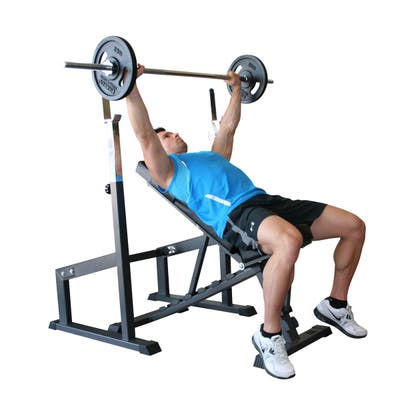
Models with a rack for a barbell also allow bench presses and shoulder presses with the barbell at different angles and grip widths, which is particularly appreciated by advanced barbell exercisers. In combination with a barbell rack, your bench can also be used for highly effective box squats.
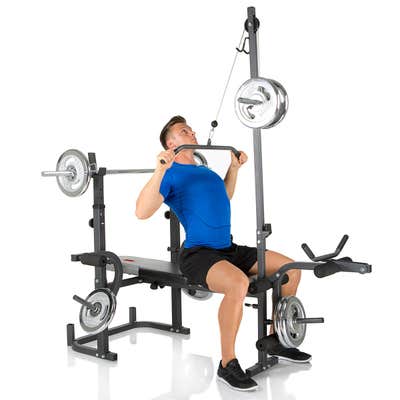
Professional weight benches such as the Bermuda series also offer you additional exercise options for your strength training and integrate typical gym exercises such as butterflies, lat pulldowns and a leg module into a weight bench. This allows you to train all muscle groups particularly effectively.
Popular exercises: Which workouts are suitable for the adjustable weight bench?
An adjustable weight bench can generally be used for all common dumbbell exercises. However, depending on your individual training preferences, there are a few points to bear in mind. For example, your training bench should be able to tolerate heavy weights for intensive bodybuilding or weight training. For example, the with a maximum load of 450 kg is ideal for this.
If you also want to use many different exercises within a workout or even organise them as circuit training, a smooth and uncomplicated adjustment of the backrest pad is particularly important. In addition to classic dumbbell training, a training bench is also a useful addition for bodyweight exercises. For example, hands or feet can be placed on the bench for different variations of planks and push-ups or effectively build muscle with bench dips or split squats.
How much weight should you start training with on a weight bench?
The optimal training intensity for you depends largely on your personal training level. Beginners should generally start with weights that can be moved 15-25 times with clean technique in each exercise and therefore benefit from training that is particularly easy on the joints. Heavy weights are therefore not necessary at the start of your training career. A weight bench with dumbbell set or a combination of incline bench, barbell and weights are therefore ideal for beginners.
Advanced and professional users can reduce the number of repetitions per set in favour of heavier weights as their training progresses and thus improve other strength abilities such as maximum strength or explosive strength. Dumbbell and barbell systems can be supplemented with additional weights for this purpose.
How do I look after my weight bench?
After buying a weight bench, you can get started right away and build muscle at home. Due to the high-quality materials and mechanisms, the training benches are generally maintenance-free and will give you long-lasting pleasure in your training. To optimise the quality of the bench, place a underneath it during training and clean it with a damp cloth after your workout.
Where can I test a weight bench?
Would you like to try out a weight bench before you buy? We look forward to your visit to one of our HAMMER stores and will be happy to advise you on your decision so that you are guaranteed to be satisfied!
FAQ
How effective is training on a weight bench for building muscle and strength?
Training on the weight bench is one of the most effective methods for visible muscle building. Stabilising muscles are additionally activated through free movement - unlike on machines. Bench presses, dumbbell rows and shoulder presses in particular promote the even development of the chest, back and arms. Progressively increasing the training weight and a clean technique are crucial. In combination with sufficient recovery and a balanced diet, you can achieve visible progress in strength and muscle definition on a weight bench in just 8-12 weeks. Advanced athletes use them specifically for maximum strength and hypertrophy phases.
How can a weight bench contribute to longevity?
A weight bench is more than just a piece of muscle equipment - it is a tool for long-term health. Strength training with free weights not only strengthens muscles, but also bones, tendons and metabolism. Regular weight training improves insulin sensitivity, reduces inflammation and increases hormone balance - all factors that are directly linked to a longer, healthier life. Regular full-body training on the weight bench in particular maintains mobility, muscle mass and coordination well into old age. In this way, the weight bench actively supports your physical performance and counteracts age-related muscle loss (sarcopenia).
How often should you train on the weight bench to see results?
For beginners, we recommend 2-3 training sessions per week, each lasting 45-60 minutes. The key is to alternate between exercise and regeneration. After 6-8 weeks of regular training, you can already see visible changes in muscle tone and posture. Advanced users can increase the frequency to 4-5 sessions or periodise the training - e.g. Monday upper body, Wednesday legs, Friday full body. Targeted training planning on the weight bench not only builds strength, but also improves endurance, metabolism and body stability - ideal conditions for sustainable muscle building and fitness.
How much space does a weight bench need and what should I bear in mind when setting it up?
Depending on the model, a weight bench requires between 1.5 m × 2 m and 2 m × 2.5 m of space - including the movement radius for dumbbells. Folding models are recommended for small flats as they can be stowed away after training to save space. When setting up, make sure the floor is level and non-slip and use a floor protection mat to avoid noise and pressure points. An area with a ceiling height of at least 2 metres is ideal so that exercises such as shoulder presses or sit-ups can be performed without restriction. Good ventilation and sufficient light also increase training quality and motivation when working out on the weight bench.
The HAMMER expert telephone
Our team of experts will also be happy to give you detailed advice over the phone. Our fitness trainers are experts in all matters relating to strength and endurance training, fitness and nutrition.
Give us a call: HAMMER expert phone: +49 731 974 88-518 (Mon - Sat 9am - 7pm). We will also be happy to call you back!


Alexander Seifried
Personal Trainer, B. Sc. Nutrition Management and Dietetics, M. Sc. Clinical Sports Therapy and Sports Physiology

